Table of Contents
Proof of the Law of Cosines
Statement
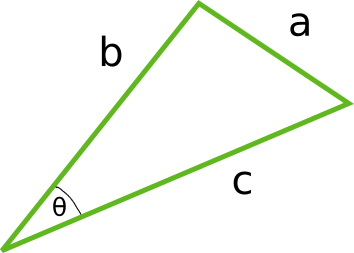
For a triangle with sides $a$, $b$, and $c$, and angle $\theta$ between sides $b$ and $c$, the Law of Cosines states:
$$ a^2 = b^2 + c^2 - 2bc\cos(\theta) $$
Proof
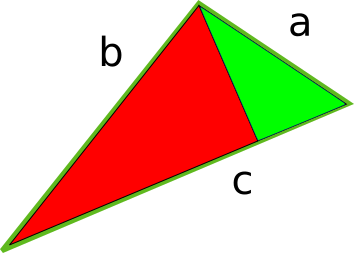
We construct the proof by splitting the triangle into two right-angled triangles.
Drop a perpendicular from the vertex opposite side $a$ onto side $c$.
Step 1: Identify the lengths
Using trigonometry in the smaller right triangle:
- The vertical height (altitude) is:
$$ b \sin(\theta) $$
- The horizontal projection of side $b$ onto side $c$ is:
$$ b \cos(\theta) $$
- Therefore, the remaining horizontal segment is:
$$ c - b \cos(\theta) $$
Step 2: Apply the Pythagorean Theorem
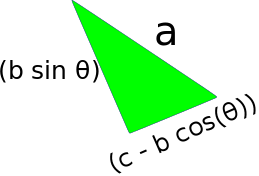
Consider the right triangle formed with:
- Vertical side: $b \sin(\theta)$
- Horizontal side: $c - b \cos(\theta)$
- Hypotenuse: $a$
By the Pythagorean Theorem:
$$ a^2 = (b \sin(\theta))^2 + (c - b \cos(\theta))^2 $$
Step 3: Expand the expression
$$ \begin{aligned} a^2 &= b^2 \sin^2(\theta) + (c - b \cos(\theta))^2 \\ \\ &= b^2 \sin^2(\theta) + c^2 - 2bc\cos(\theta) + b^2 \cos^2(\theta) \end{aligned} $$
Rearrange terms:
$$ a^2 = b^2 \sin^2(\theta) + b^2 \cos^2(\theta) + c^2 - 2bc\cos(\theta) $$
Step 4: Use a trigonometric identity
Recall the identity:
$$ \sin^2(\theta) + \cos^2(\theta) = 1 $$
Substitute:
$$ a^2 = b^2(1) + c^2 - 2bc\cos(\theta) $$
Final Result
$$ a^2 = b^2 + c^2 - 2bc\cos(\theta) $$
Why this works (Intuition)
The proof works by:
- Breaking the triangle into right triangles (where we can use the Pythagorean Theorem)
- Expressing unknown lengths using sine and cosine
- Reassembling everything into a single equation
The extra term $-2bc\cos(\theta)$ accounts for the fact that the triangle is not necessarily a right triangle.
Summary
- The Law of Cosines generalizes the Pythagorean Theorem
- It works for all triangles, not just right-angled ones
- It is essential in geometry, physics, engineering, and computer graphics
Discussion